
NEW ENGLAND ARTS ORGANIZATIONS STILL FEELING IMPACTS OF FEDERAL FUNDING CUTS

Image of the Make Way for Ducklings public art installation in the Boston Public Garden. Floating triangles to the left are decorative.
BACKGROUND
When the Trump Administration released its federal budget proposal for FY2026, arts and cultural organizations across New England faced immediate uncertainty. This budget called to eliminate funding for key federal cultural institutions, including the National Endowment for the Arts (NEA), National Endowment for the Humanities (NEH), and the Institute of Museum and Library Services (IMLS). Soon after, many organizations that had already been awarded grants from these agencies received notice that their funding would be terminated. Grants that were previously approved but not yet distributed were rescinded and organizations with active contracts faced disruptions in anticipated funding.
In early 2025, MASSCreative, Arts4NH, CT Arts Alliance, and the Cultural Alliance of Maine conducted a survey to assess the impacts of those federal funding cuts. In the first survey, 89 organizations in New England reported $4.2 million in lost grant funding, impacts to 810 jobs, and 63 grant cancellations - mostly from the NEA (73%).
To continue measuring the impacts of lost federal funding, MASSCreative, Arts4NH, CT Arts Alliance, Cultural Alliance of Maine, New England Foundation for the Arts, and Vermont Creative Network administered a second regional impact survey in early 2026.
These survey responses help us better understand the consequences of these cuts to the region’s cultural economy.
KEY TAKEAWAYS FROM THE 2026 SURVEY
Here’s What We Found Across New England in 2026:
Arts and culture grant funding extends far beyond performances and exhibits. Agencies like the NEA, NEH, and IMLS distribute hundreds of millions of dollars annually to organizations to support a wide range of community services, including but not limited to educational initiatives, programs for historically underserved communities, youth development opportunities, mental health and wellness programs, public access to libraries and museums, and more.
Here’s what we found:
125 groups responded to the survey.
$13.5 million in total funding was eliminated, suspended, or unavailable.
720 jobs were supported by these grants, many of which are now at risk.
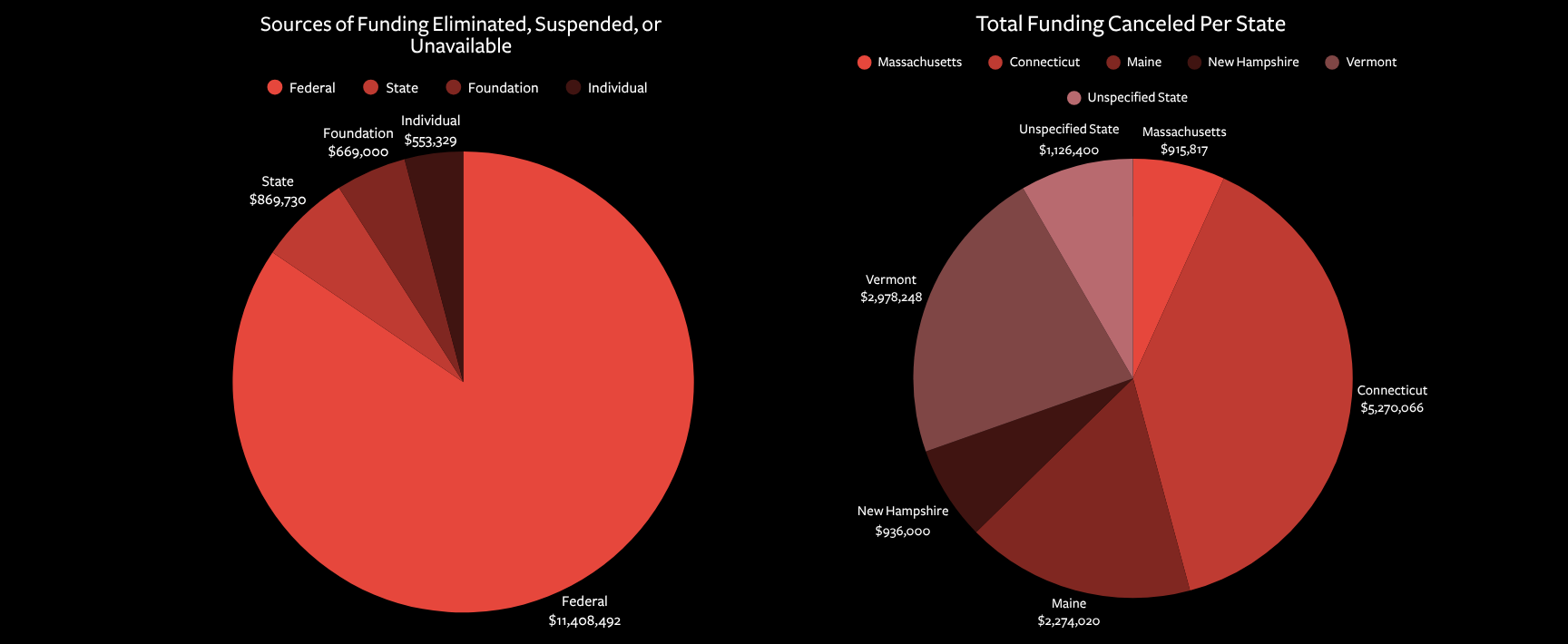
Total Funding Eliminated, Suspended, or Unavailable:
In total, $13.5 million in total funding was eliminated, suspended, or unavailable.
Total Federal funding rescinded: $11,408,482
Total State funding rescinded: $869,730
Total Foundation funding decrease: $669,000
Total Individual donor funding decrease: $553,329
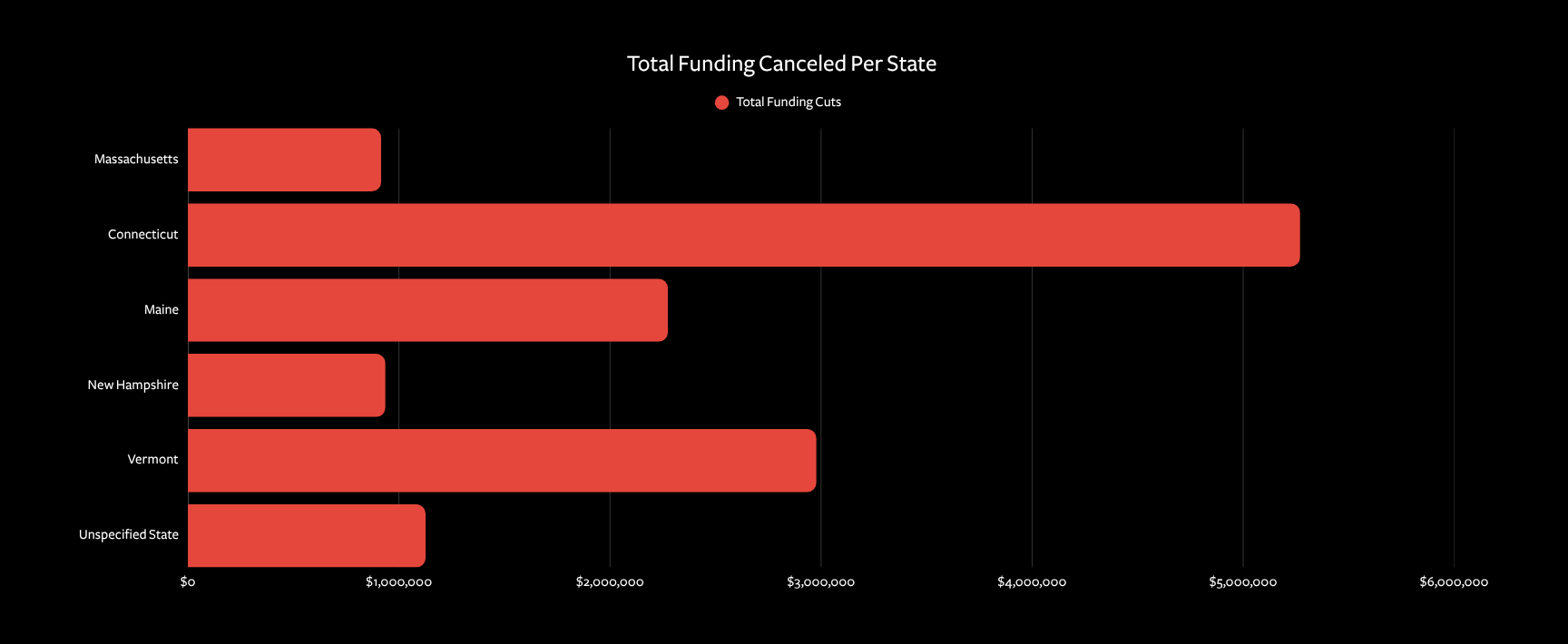
Total Funding Canceled Per State:
Massachusetts: $915,817
Connecticut: $5,270,066
Maine: $2,274,020
New Hampshire: $936,000
Vermont: $2,978,248
Unspecified States (organizations did not report a state): $1,126,400
FEDERAL FUNDING IMPACTS
42 federal grants were canceled, most of them from the NEA (40.5%), impacting 36 organizations
28 entire federal grant programs have been terminated, affecting 22% of organizations that previously received funding
45 organizations (36% of organizations) can no longer pursue a total of $7,144,000 in federal funding due to eligibility or compliance changes
STATE FUNDING IMPACTS
34 organizations (27.2%) reported a decrease in state funding.
State funding decreased by approximately $869,730.
19 entire state grant programs have been terminated, affecting 15.2% of organizations who were previously awarded grants
13 organizations (10.4%) can no longer pursue a total of $156,000 in state funding due to eligibility or compliance changes
Massachusetts:
$915,817 total funding cut across 23 organizations
$710,293 from 12 federal grants cut from 9 organizations after awarded, 50% from NEA
$170,000 cut from state funding
$27,500 decrease in foundation funding
$8,024 decrease in individual donor funding
171 jobs affected
51 jobs fully or partially supported by federal funding
120 jobs fully or partially supported by state funding
Connecticut:
$5,270,066 total funding cut across 39 organizations
$4,713,951 from 8 federal grants cut from 7 organizations after awarded
$226,730 cut from state funding
$191,500 decrease in foundation funding
$137,885 decrease in individual donor funding
142 jobs affected
89 jobs fully or partially funded by federal funding
53 jobs fully or partially funded by state funding
Maine:
$2,274,020 total funding cut across 31 organizations
$1,765,000 from 8 federal grants cut from 8 organizations after awarded
$24,000 cut from state funding
$265,000 decrease in foundation funding
$220,020 decrease in individual donor funding
49 jobs affected
48 jobs fully or partially funded by federal funding
1 job fully or partially funded by state funding
New Hampshire:
$936,000 total funding cut across 13 organizations
$453,000 from 5 federal grants cut from 4 organizations after awarded, 40% from NEA
$213,000 cut from state funding
$100,000 decrease in foundation funding
$170,000 decrease in individual donor funding
148 jobs affected
104 jobs fully or partially funded by federal funding
44 jobs fully or partially funded by state funding
Vermont:
$2,978,248 total funding cut across 8 organizations
$2,888,248 from 3 federal grants cut from 3 organizations after awarded
$60,000 cut from state funding
$25,000 decrease in foundation funding
$5,000 decrease in individual donor funding
126 jobs affected
122 jobs fully or partially funded by federal funding
4 jobs fully or partially funded by state funding
Unspecified States:
$1,126,400 total funding cut across 11 organizations
$878,000 from 6 federal grants cut from 5 organizations after awarded, 50% from the NEH
$176,000 cut from state funding
$60,000 decrease in foundation funding
$12,400 decrease in individual donor funding
84 jobs affected
72 jobs fully or partially funded by federal funding
12 jobs fully or partially funded by state funding
JOBS IMPACTED
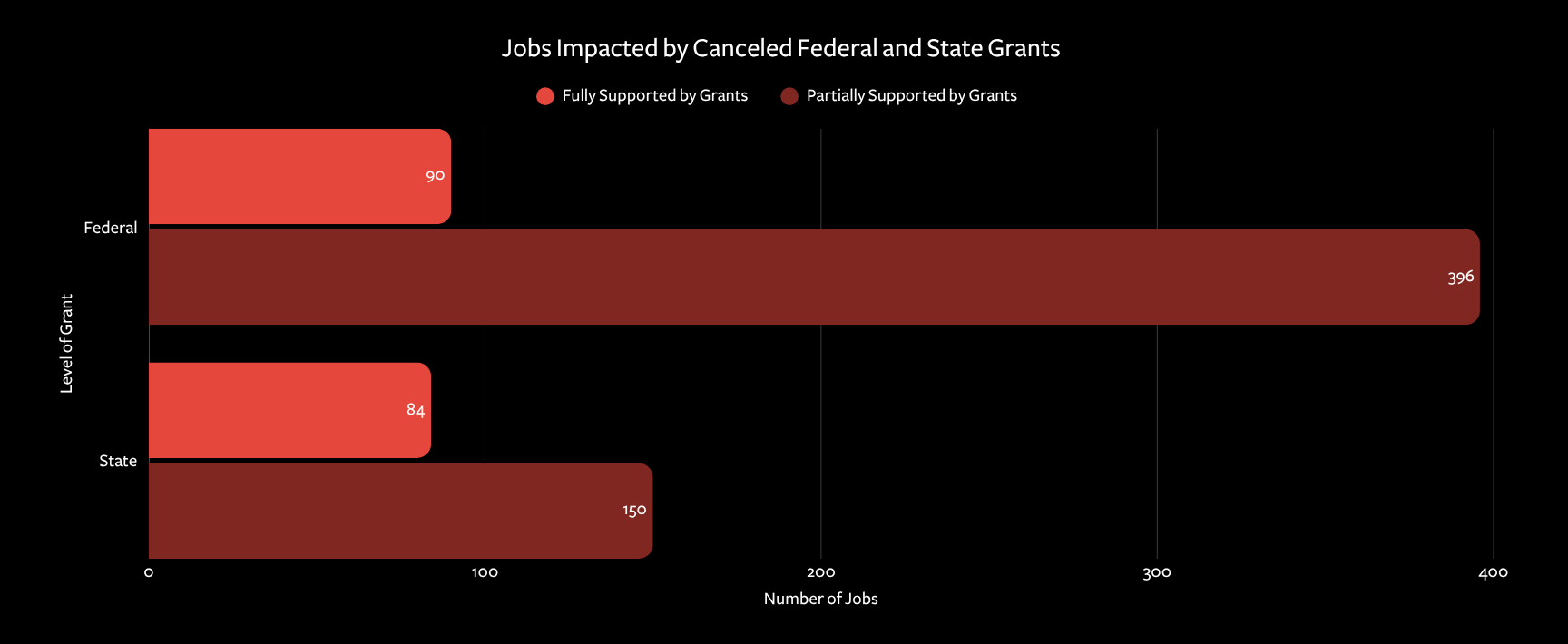
In total, 486 jobs were affected by canceled FEDERAL grants. Respondents reported that 90 jobs were fully supported by canceled federal grants, while 396 jobs were partially supported by canceled federal grants.
In total, 234 jobs were affected by canceled STATE grants. Of those jobs, 84 were fully supported by canceled state grants, while 150 were partially supported by canceled state grants.
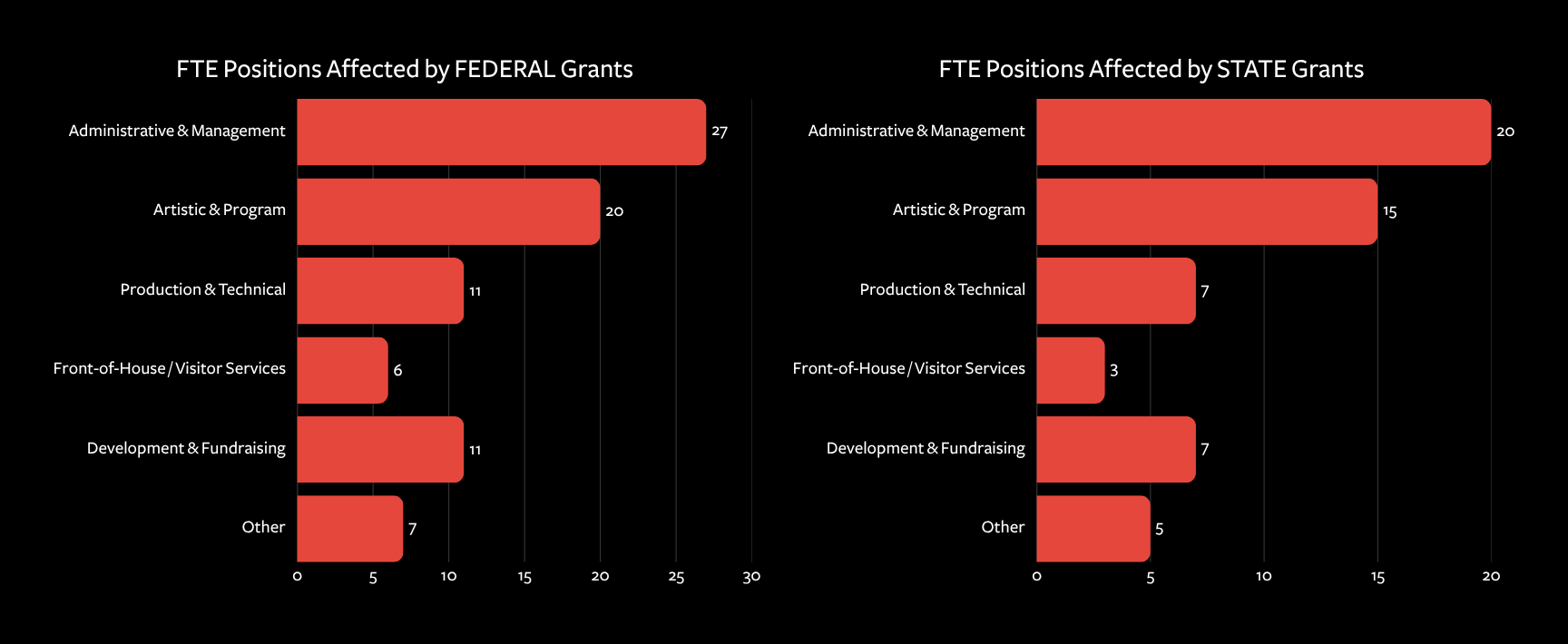
Overall, 720 jobs have been affected by canceled federal or state grants. The following graph breaks down the range of positions that relied fully or partially on grant funding, illustrating which areas of the workforce experienced the greatest impact.
FTE Positions Affected by Federal and State Grants:
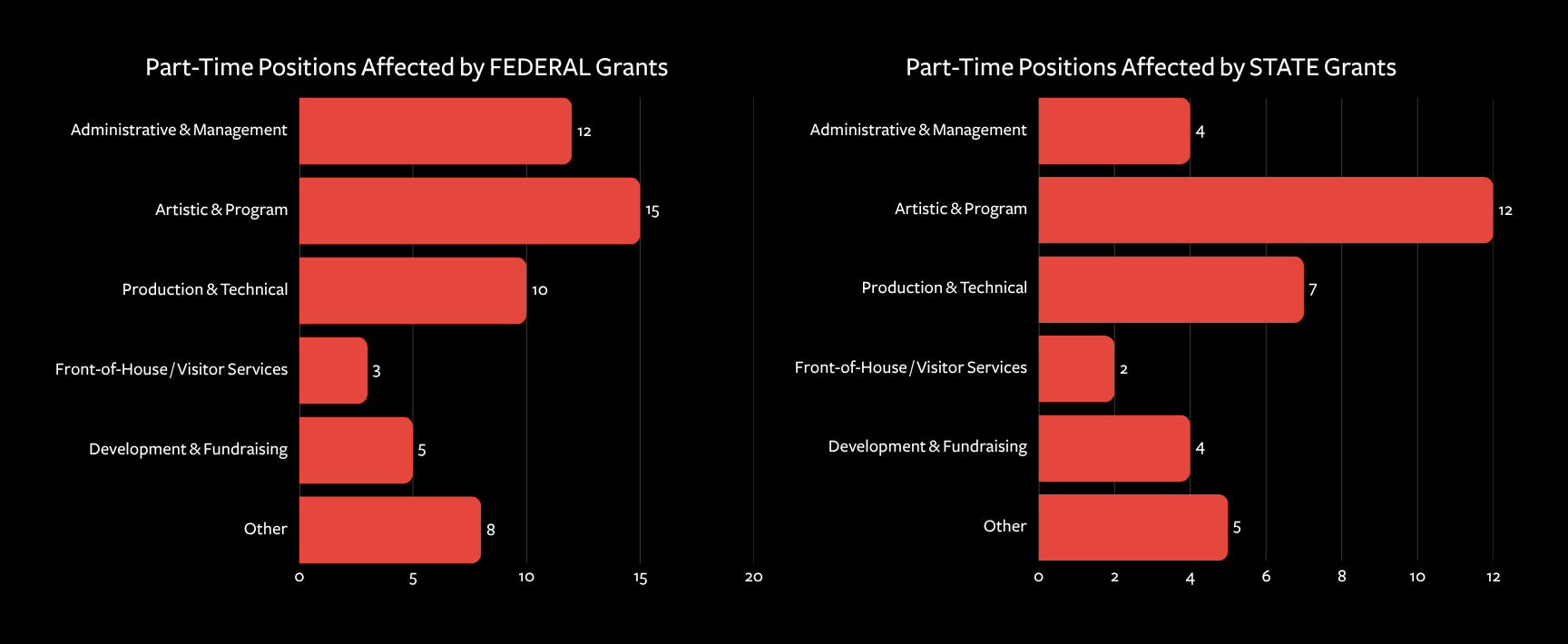
Part-Time Positions Affected by FEDERAL and STATE Grants:
Of all FTE positions, federal and state grants primarily affected Administrative & Management roles (32.9% affected by federal grants, 35.1% affected by state grants), with Artistic & Program roles being the second most impacted (24.4% affected by federal grants, 26.3% affected by state grants).
Of all part-time positions, both federal and state grants affected Artistic & Program roles the most (28.3% affected by federal grants, 35.3% affected by state grants). Administrative & Management roles were the second most impacted part-time positions by federal grants (22.6%), while Production & Technical roles were the second most impacted part-time positions by state grants (20.6%).
HIGHER STAKES FOR FUNDRAISING
As funding disappears, communities risk losing not only arts programming but also essential services that contribute to their learning and well-being.
67 organizations (53.6%) reported increasing their reliance on state or local funding sources as a result of losing federal grants. This places additional pressure on state and local funding sources that are already being stretched to address other urgent needs created by other federal budget cuts.
Federal funding decisions influence the broader philanthropic landscape as priorities shift away from arts and culture. Foundations and individual donors often reassess their own giving strategies, creating uncertainty for nonprofit organizations. In the past year, there has been a $7,332,051 approximate net change in foundation funding across all New England respondents, indicating significant changes within organizations and their resources.
IMPACTS ON FUNDRAISING:
29 organizations (23.2%) report a decrease in private foundation funding
34 organizations (27.2%) report a decrease in individual donor funding, while 49 organizations (39.2%) report an increase in individual donor contributions
Major donors (32.4%), small donors (39.4%), and memberships (14.1%) are the leading individual contributions that decreased
Organizations reported a total estimated $6,175,860 net increase in foundation funding, while also reporting an approximate $553,329 in lost foundation funding
While foundation support can help mitigate the effects of federal cuts, private donors cannot fully replace the consistency and scale of federal investment in arts and culture. Despite their efforts, funding remains uneven across the sector, with some organizations experiencing gains while others faced significant losses. As organizations compete for alternate funding sources, many continue to face instability regarding long-term sustainability.
WHAT HAPPENS WHEN GRANTS ARE CANCELED?
As a result of funding loss, organizations may have no choice but to eliminate or reduce their full-time or part-time staff positions; contract positions; program, exhibit, production, or public services; and operating hours or scale of services.
30 organizations reported decreasing their programs, exhibits, productions, or public services due to federal or state budget cuts.
Beyond budget shortfalls and job loss, these grants supported programs for:
Youth and students (21.6%) and aging populations (12.8%)
Low-income communities (20%)
Rural (14.4%), suburban (13.6%) and urban (16.8%) residents
BIPOC communities (17.6%)
Immigrant or refugee communities (10.4%)
WHAT’S NEXT?
Despite continuous bipartisan congressional support for federal arts and culture funding, President Trump’s proposed FY2027 budget again called for cuts to arts and cultural institutions. This marks the sixth time since 2016 that the Trump Administration has attempted to shut down the NEA and NEH. Congress routinely maintains funding for the NEA and NEH.
Recurring proposals to cut federal arts and culture institution funding underscore a volatile and vulnerable landscape for the creative sector and creative economy in the United States.
When historically relied upon federal funding is undermined, the pain is acutely felt in local communities that depend on federal support to ensure the arts are accessible to all. When funding disappears or proves unreliable, so do the jobs and opportunities it creates.
This survey demonstrates how federal arts and culture funding is a critical investment for programs, services, and resources that strengthen our communities. Behind these numbers are after-school programs, local jobs, and historical preservation efforts that enrich the lives of people throughout New England.
This report was published with assistance from MASSCreative interns Brennis Carrillo and Allaine Lara.