
160+ BOSTON ARTISTS AND ARTS LEADERS REJECT PROPOSED 27% CUT TO ARTS AND CULTURE FUNDING
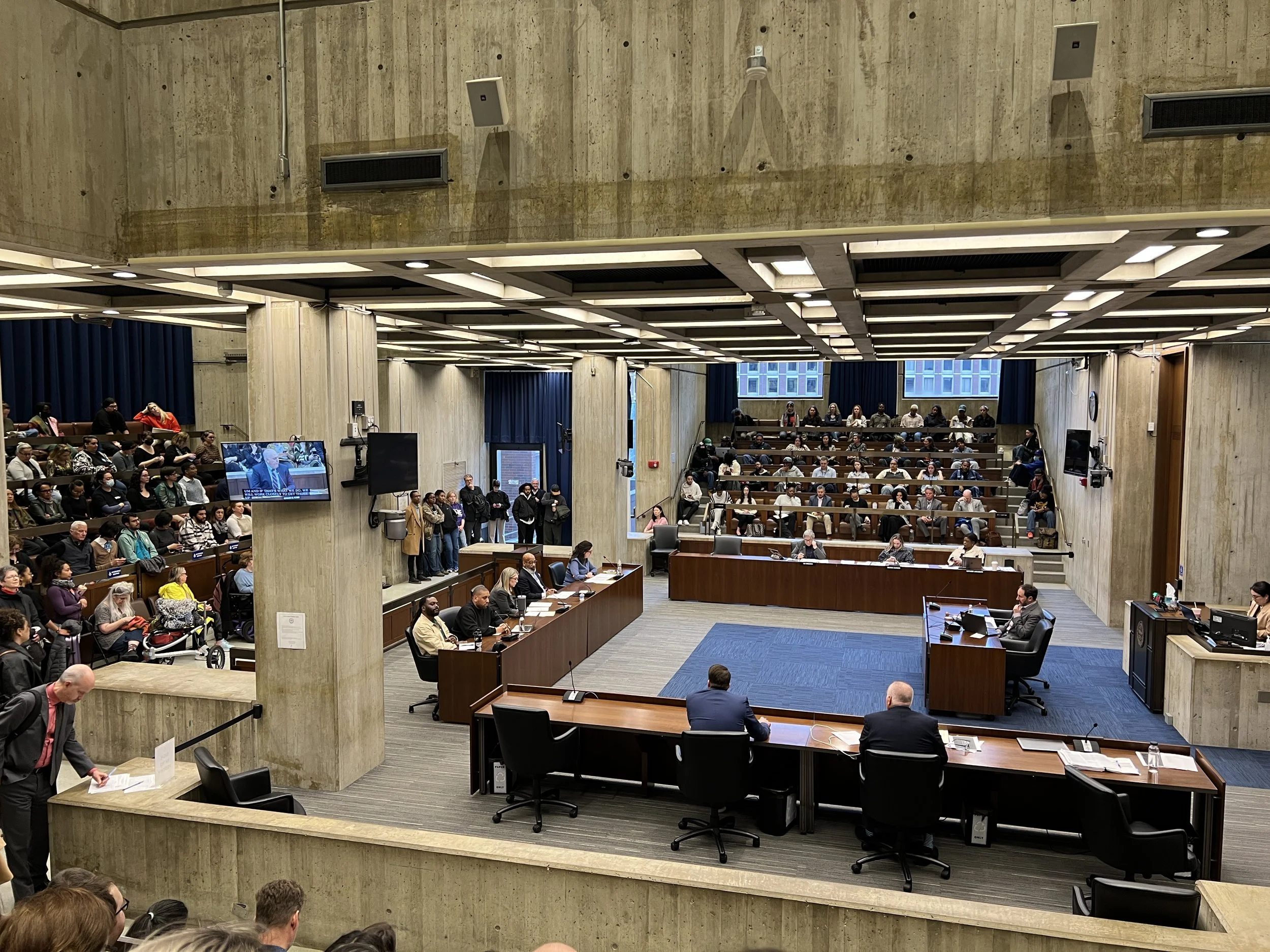
Image of arts advocates at the April 30, 2026 Boston City Council budget hearing.
More than 160 artists, teaching artists, arts leaders, and representatives from arts organizations across Boston gathered at Boston City Hall on Thursday, April 30, 2026 to advocate for the restoration of the City’s FY2027 Arts and Culture budget during a nearly four-hour long City Council budget hearing.
The budget hearing chaired by City Councilor Benjamin Weber in the Iannella Chamber drew such a large turnout that the room quickly reached capacity, becoming standing room only. Due to the overwhelming attendance, staff established an overflow area where additional advocates watched the proceedings via livestream.
Attendees delivered testimony urging City Councilors to reject the proposed 27% reduction to the Mayor’s Office of Arts and Culture. The proposed $1.2 million in cuts come as Boston faces a broader budget gap of nearly $50 million driven by rising costs in areas such as public safety, health care, and snow removal. The proposed cuts would eliminate critical community-based grants, reduce staff capacity within the Mayor’s Office of Arts and Culture, and disrupt the city’s Artists in Residence program.
“A budget is a moral document. It tells us more clearly than anything else where our priorities lie..It is incredibly disheartening to learn that the arts are not a priority in the City of Boston.”
Speakers at the hearing emphasized the creative sector’s substantial economic and social impact. Boston’s creative industries contribute an estimated $15 billion annually to the local economy. Additionally, 18% of Boston residents report that the creative economy is their primary source of income, 7.5% report it’s their secondary source of income, and the city’s creative workforce has grown by 5.2% since 2021, demonstrating its continued expansion despite ongoing funding challenges. Creative industries support the employment of 70,000 workers in Boston.
“The proposed $1 million cut in arts funding is not just a cultural decision, it’s an economic one. That loss shows up in very real ways. It shows up in fewer customers at neighborhood restaurants before and after performances, and it shows up in fewer dollars circulating through small businesses in neighborhoods like East Boston, Roxbury, and Dorchester, communities where arts organizations often serve as economic anchors.”
Advocates also situated the proposed cuts within a broader national and statewide context of instability for the arts sector. Over the past year, federal actions have significantly disrupted cultural funding, including widespread grant terminations and staff layoffs at the National Endowment for the Humanities, efforts to dismantle the Institute of Museum and Library Services, and proposals to eliminate the National Endowment for the Arts in the federal FY2027 budget. In early 2026, the Corporation for Public Broadcasting voted to dissolve following federal funding cuts, further destabilizing the national cultural infrastructure.
At the same time, the arts sector continues to recover unevenly from the COVID-19 pandemic. The expiration of ARPA funding, declining private philanthropy, and reduced earned revenue have compounded financial strain. Data from SMU DataArts shows that Massachusetts cultural organizations reduced their budgets by an average of 12% in 2022, with earned revenue down 34% and attendance declining 47% since 2019. Contributed income has also dropped significantly across individual, corporate, and foundation sources, with particularly sharp losses among larger organizations and performing arts groups.
“All eyes are on Boston right now for reasons other than the 250th and sports. City funding signals that art matters...Every time I go to a new foundation, a new donor and they’re really excited about public art, they say, is the city funding you? And I have to say yeah they are. I don’t want to go to them and say the city just reduced the budget by $1 million. ”
Testimony underscored the broader community consequences of the proposed cuts, particularly for youth and historically underserved communities. Advocates argued that reductions to arts funding would further erode access to creative opportunities, workforce development pathways, and culturally relevant programming at a time when the sector is already under strain.
“Divesting from arts and culture is an investment in our division. We don’t have a talent, intelligence or hustle problem, we have an infrastructure problem. This isn’t just arts funding, this is cultural economics and workforce development. Restore the $1 million, but don’t just restore the budget - build an infrastructure that makes this conversation obsolete. Not just more events, but more ownership of the establishments that produce them, more access to capital that allows creatives and cultural workers to scale, that makes a partnership of our relationship to our city not one of servitude.”
The advocacy effort was organized and led by Arts Activate Boston, a coalition of arts and culture leaders in Boston. They spent the last two weeks mobilizing Boston’s arts sector to attend the hearing and give testimony. Organizers continue to urge creative workers and residents to engage with City Council members and advocate for the full reinstatement of the arts and culture budget ahead of the beginning of the new fiscal year on July 1.