COMPLETE 2026 SUMMIT SCHEDULE AND WORKSHOPS
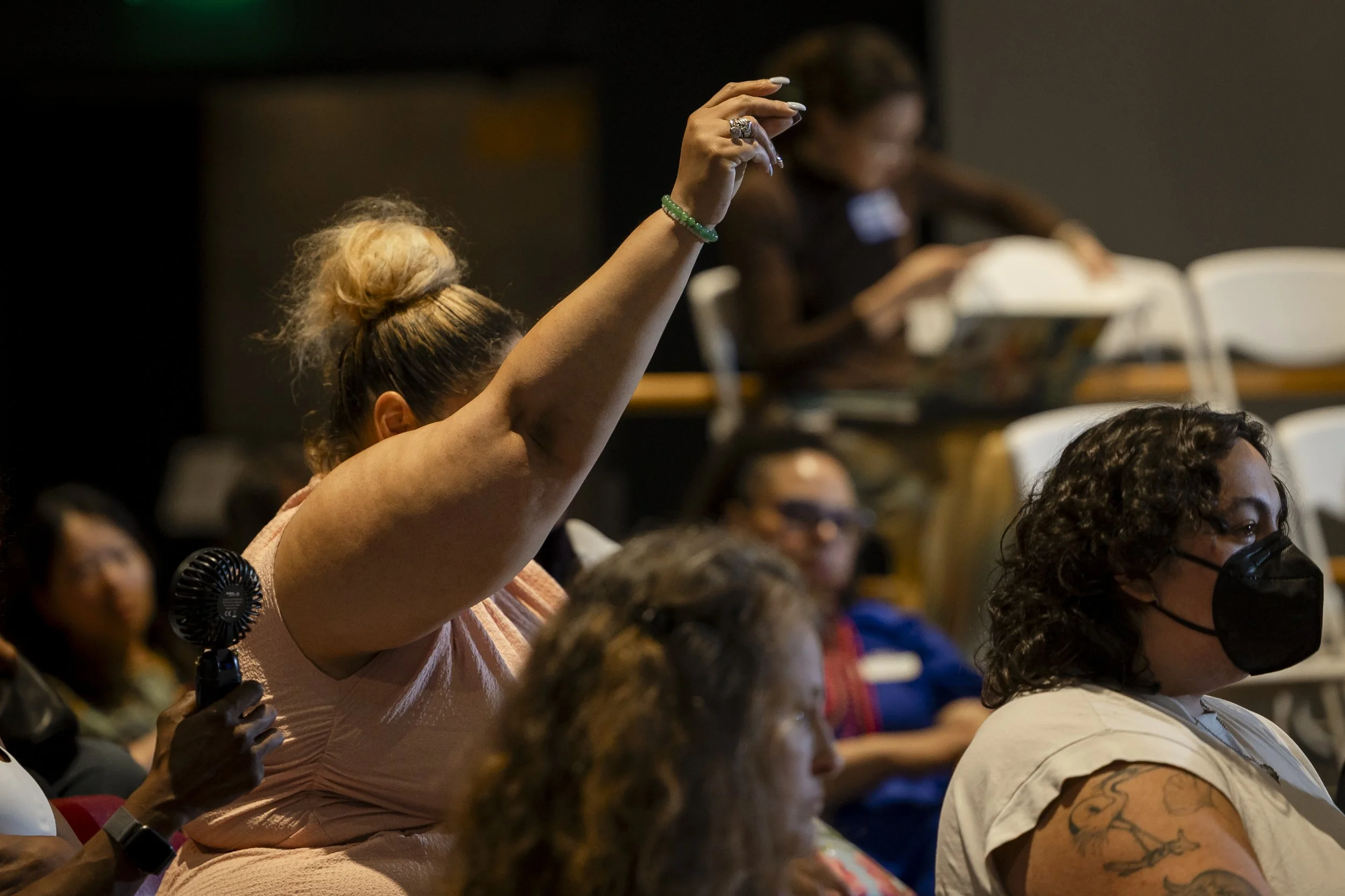
Attendee raises a hand at the 2025 Creative Sector Summit. Photography by Steph Craig Studios.
We’re proud to bring the third annual Creative Sector Summit to the Zeiterion in New Bedford on Friday, June 12, 2026. This annual convening will feature expert panels, policy discussions, workshops, and case studies to support artists in their advocacy, advance cultural policy development, and increase civic engagement within the creative sector in Massachusetts.
This blog contains a complete schedule, detailed information about this year’s featured workshops and sessions, and downloadable programs for you to reference throughout the event. Read on for more information about this year’s Summit.
LEARNING TRACKS
The theme of this year’s Summit is “Art, Culture and Creativity as Civic Infrastructure.” We will offer four different optional learning tracks that attendees may choose to follow throughout the day. Learning track sessions will run consecutively so you can take all of them if you so choose.
Learning Tracks:
-
Focus of learning track: How art and cultural expression shape, activate, and sustain meaningful community spaces.
Featured sessions:
(11 - 11:50 AM)
Get Organized! #ARTSTAYSHERE’s Tools to Prevent Artist Displacement. Located in the Movement Studio.
(2 - 3 PM)
(HYBRID) Civic Infrastructure for Aesthetic Justice: What Public Art Makes Possible. Located in the Main Theater.
(3:10 - 4:10 PM)
ñ press: making and learning together. Located in the Movement Studio.
-
Focus of learning track: How to advance strategies that support artists and creative workers as essential to thriving local economies.
Featured sessions:
(11 - 11:50 AM)
Access for All: The CMSS–SPS Partnership Story. Located in the Donor Lounge.
(2 - 3 PM)
The Creative Sector in the Economy: Reframing Its Role. Located in the Speakeasy.
(3:10 - 4:10 PM)
Making Space for Art: Local Policy Tools for Creative Space. Located in the Donor Lounge.
-
Focus of learning track: How to leverage creative practices to build belonging, bridge divides, and strengthen community well-being.
Featured sessions:
(11 - 11:50 AM)
(HYBRID) The Urban/Rural Divide: Queer Art as a Guide for Bridging the Gap. Located in the Main Theater.
(2 - 3 PM)
En Ruta con BoriCorridor: Tours, Map, and Culture to connect with the Diaspora. Located in the Movement Studio.
(3:10 - 4:10 PM)
Pitch Perfect: How We Get More Arts Policy Stories in the News. Located in the Speakeasy.
-
Focus of the learning track: How to embed art, culture, and creativity across sectors.
Featured sessions:
(11 - 11:50 AM)
Community Connections: Co-creating Arts Experiences that Amplify. Located in the Speakeasy.
(2 - 3 PM)
Building the Base: How New Bedford Legislated Sustainable Arts Funding. Located in the Donor Lounge.
(3:10 - 4:10 PM)
(HYBRID) The Creative Workaround: Funding Civic Solutions with Non-Arts Dollars. Located in the Main Theater.
Attendees are not required to pick a learning track and may choose to attend whichever sessions interest them. This offering is merely available to support your learning.
LIVESTREAM PROGRAM
For the first time, we are offering livestreamed programming at the Summit for advocates to participate from anywhere. If you purchased a livestream ticket, you will have access to view the following sessions:
(10:20 - 10:50 AM) Welcoming remarks from Emily Ruddock, Rosemary Gill, Mayor Jon Mitchell,
Rep. Tony Cabral, and Mass Cultural Council’s Acting Executive Director David T. Slatery
(11- 11:50 AM) The Urban/Rural Divide: Queer Art as a Guide for Bridging the Gap
(2 - 3 PM) Civic Infrastructure for Aesthetic Justice: What Public Art Makes Possible
(3:10 - 4:10 PM) The Creative Workaround: Funding Civic Solutions with Non-Arts Dollars
(4:30 - 5:30 PM) Keynote address and fireside chat with Ngoc-Tran Vu.
ASL and CART services will be available for all of these sessions.
SUMMIT SCHEDULE & WORKSHOP LISTING
This program was developed in partnership with the 2026 Summit Host Committee, who reviewed all of the session proposals with MASSCreative’s staff. Led by creative sector leaders from communities across the Commonwealth, this year’s program will provide attendees with a diverse offering of insightful workshops and panels to help you become a more confident, knowledgeable, and effective advocate.
REGISTRATION, BREAKFAST & NETWORKING - (9:30 - 10:20 AM)
OPENING PROGRAM - (10:20 - 10:50 AM)
Welcoming remarks from Emily Ruddock, Rosemary Gill, Mayor Jon Mitchell, Rep. Tony Cabral, Rep. Carole Fiola, and Mass Cultural Council’s Acting Executive Director David T. Slatery in the Main Theater.
ASL and CART services will be available for this session.
SESSION ROUND #1 - (11 - 11:50 AM)
-
Location: Main Theater
Learning Track: Arts, Humanities, and Civic Health
ASL and CART services will be available for this session.
Led by Double Edge Theatre's Producing Director Cariel Klein (they/she) and The Theater Offensive’s Associate Director of Queer (Re)Public & QR Festival Director Des Bennett (they/them)
This session will be a case study conversation around the multi-year partnership between Double Edge Theatre and The Theater Offensive. Through shared programming, they have bridged a gap between Double Edge's reality, which mostly deals with rural issues, and The Theater Offensive's, which focuses on presenting art by, for, and about queer and trans people of color in the city. They have learned much from this cultivation, and seen how to support each other in a "long-distance relationship", which spans conversations of mentorship, shared goals and issues, and mutual learning. This kind of partnership, which is based in actual artistic work, offers a model for those who are interested in deep partnership.
-
Location: Donor Lounge
Learning Track: Creative Economy and Workforce Development
Led by Rachel Rivard at the Community Music School of Springfield (CMSS) and Gary Bernice at Springfield Public Schools
This session traces the evolution of music education in Springfield over the past 15 years. In 2014, after decades of cuts to music in Springfield Public Schools (SPS), SPS’s Director of Visual & Performing Arts and the Executive Director of CMSS formed a partnership to rebuild music education in schools. Their shared goal was simple but powerful: meaningful, high-quality music education for every student.
The partnership began with Sonido Música, serving 60 students in 3 SPS schools. Its vision was to provide in-school music instruction for 3 years while schools prepared to hire their own music teacher. In 2019, that vision became reality when SPS School Committee committed to placing a music and art teacher in every school. Sonido evolved to support these educators while expanding to Holyoke Public Schools. Recognizing students with high support needs often lacked access to music, and educators needed additional support, the partnership launched Adaptive Music Program (AMP) in 2016. Together, Sonido & AMP strengthened trust between CMSS and SPS and expanded opportunities such as free CMSS ensembles for Sonido and AMP students.Today, Sonido and AMP reach 1,847 students weekly; AMP serves 32 SPS schools and Sonido serves 24 SPS schools. The partnership now extends into professional development, workforce development, internships, college readiness, and after-school programming through IGNITE, where SPS students and teachers travel monthly to CMSS for expanded arts learning.
-
Location: Movement Studio
Learning Track: Creative Placekeeping and Public Art
Led by Ami Bennitt, Ethan Dussault, and Cristina Todesco
Artist displacement is a decades-old problem facing Massachusetts’ creative sector. Over the past 6 years, the #ARTSTAYSHERE Coalition (ASH), has worked to change the trajectory, helping to preserve Humphreys Street Studios, Charlestown Rehearsal Studios, and Central Street Studios, and to relocate over 700 musicians displaced from Brighton’s Sound Museum and add over 100,000 square feet of new affordable arts space in Somerville. Through custom advocacy campaigns, ASH works with artist workspace communities to preserve the affordable artist workspaces we have and help build more inventory of and policies/protections for more inventory of affordable artist workspaces statewide. ASH will share tools to prevent artist displacement because if you don’t own it, it’s at risk.
-
Location: Speakeasy
Learning Track: Cross-Sector Integration
Moderated by Emma York with panelists Mark Dressel, Maia Livramento, and Carl Alves
People in New Bedford die of drug overdoses at twice the statewide rate and the city has some of the highest incarceration rates in Massachusetts. The Zeiterion piloted a program that uses the arts to amplify the impact of the community organizations working to address these issues. Community Connections brings together people directly impacted by or involved in addressing an issue relevant to our community to design a weeklong artist residency featuring a touring artist whose work touches on that issue. This year’s residency featured singer songwriter Matt Bulter, whose one man show Reckless Son speaks to the ways people navigate addiction, incarceration, and suicidal ideation by merging Matt’s story with the stories of the people he met performing in prisons and jails across the country. This panel discussion will bring together some of the individuals who designed and executed his residency, including a Teen Ambassador who moderated a Stories of Recovery & Reentry panel and Narcan training, a poet in recovery who shared her story at that panel, and the Chief Executive Director of Positive Action Against Chemical Addiction. Each panelist will share the challenges and rewards of cross-sector collaboration and support audience members to imagine how they can co-create arts experiences that support people working to address the issues impacting their communities daily. We will examine how arts institutions can foreground the expertise of those with direct lived experience of systemic oppression.
SESSION ROUND #2 - (12 - 1 PM)
Facilitated group conversations in the Main Theater, Movement Studio, Speakeasy, and Donor Lounge. Participant name tags will include room assignments.
This will only be available for the in-person audience.
LUNCH & PARTICIPATORY ARTMAKING AT THE Z & STAR STORE - (1 - 1:50 PM)
Sponsored by MassDevelopment and New Bedford Creative.
Lunch will be provided by D&D Catering at the Zeiterion. Participatory artmaking activities provided by Raw Art Works and Alder & Alder will be available in the Star Store.
Artmaking Activities:
-
Presented by Raw Art Works (RAW)
What moves beneath the surface of a city? What forces, invisible but real, shape how communities connect, sustain themselves, and rise?
Undercurrents is a drop-in participatory art activity with watercolor inviting Summit attendees to create during the lunch break. Rooted in the work of Raw Art Works (RAW), a Creative Youth Development organization based in Lynn, MA, this activity draws from RAW's 2025-2026 exhibit theme and the lived experience of gateway city communities across Massachusetts. -
Presented by Alder & Alder
In this hands-on activity, participants will learn to fold a one-sheet mini-zine and fill it with text, illustrations, and/or collage. You will receive written prompts and example zines related to placekeeping, collective memory, and stories of marginalized communities. Participants will learn about the unique qualities of zines and their potential as small, defiant acts of placekeeping.
SESSION ROUND #3 - (2 - 3 PM)
-
Location: Main Theater
Learning Track: Creative Placekeeping and Public Art
Moderated by Danielle Amodeo (Arts Equity Group) with panelists Lori Lobenstine (DS4SI), Kim Szeto (New England Foundation for the Arts), and Jason Montgomery (Attack Bear Press, 50 Arrow Gallery)
What do we mean when we say art is public infrastructure? Not just that it fills public space, but that it holds communities together, makes justice legible, and expands our collective imagination of what public life could be.
This panel brings together practitioners across creative, funding, and organizing landscapes to explore "aesthetic justice"- the idea that all people have a right not just to survive, but to inhabit spaces that affirm their dignity, reflect their cultures, and activate their imaginations.
Drawing on the DS4SI Aesthetic Justice Manifesto, NEFA's Public Art Impact Assessment, and public artworks by Jason Montgomery of 50 Arrow Gallery, they will examine how artists are building essential civic infrastructure through two complementary frameworks:
Impact Assessment - which grounds us in the measurable, documentable reality of what artists do in and for communities.
Aesthetic Justice - which helps identify what we're truly striving for: spaces, cities, and public life worthy of the people who inhabit them.
Artists like Jason Montgomery and the collective at 50 Arrow Gallery embody both: their work is documented, funded, and evidence-based, and it is also something more. An ofrenda, for instance, is not just a public art installation. It’s an act of "public making" - the deliberate, aesthetic construction of shared worlds that change our physical, social, and spiritual spaces, and open up new visions of what those spaces could become. -
Location: Movement Studio
Learning Track: Arts, Humanities, and Civic Health
Led by Elsa Mosquera (Ágora Cultural Architects)
This session offers a case study and deep dive into BoriCorridor, an initiative developed by Ágora to strengthen the visibility and circulation of Puerto Rican artists across key U.S. mainland cities. BoriCorridor operates on the premise that diaspora communities are living cultural infrastructure, and that creating pathways for artists to reach them is an act of civic and artistic necessity. By connecting Puerto Rican artists to presenters, venues, and communities across the Northeast and beyond, it bridges the geographic and institutional gaps that often leave diaspora artists underrepresented in mainstream presenting circuits.
Presenters will trace the trajectory of the initiative from its origins through its touring activity and introduce its digital mapping component, a publicly accessible tool featuring several hundred organizations across the BoriCorridor network, designed to make Puerto Rican cultural infrastructure navigable for artists, presenters, and community organizations alike. Participants will hear from Ágora's Principal, Elsa Mosquera, about the lessons learned, the challenges of sustaining a diaspora-centered cultural corridor, and the opportunities for replication by other organizations working with immigrant and diasporic communities. The session may close with an open Q&A, inviting attendees to share feedback, identify potential partnerships, and explore how this model might inform their own work. -
Location: Speakeasy
Learning Track: Creative Economy and Workforce Development
Moderated by Tiffany Allecia M.Ed, (Executive Director, Springfield Creative City Collective) with panelists Dee Boyle-Clapp (Director of the Arts Extension Service, University of Massachusetts Amherst), Cassandra Holden (Executive Director, Bombyx Center for Arts & Equity), and Brianna Drohen (Co-founder & CEO, LaunchSpace)
This panel will ground the conversation in real examples from the field, highlighting how creative businesses generate revenue, create jobs, and build community infrastructure. Panelists will share models such as maker spaces and creative entrepreneurship programs that support business growth while also building transferable workforce skills.
The session will directly address why the creative economy is undervalued, including:
Misalignment with traditional workforce and economic development frameworks
Difficulty measuring creative work using standard economic metrics
Persistent cultural perceptions that creative careers are not “real work”
The panel will also focus on solutions and advocacy strategies, including:
Aligning creative sector programs with workforce development goals and funding streams
Improving data collection and storytelling to better demonstrate economic impact
Building partnerships with workforce boards, municipalities, and regional planning agencies
Investing in shared infrastructure that lowers barriers for entrepreneurs
Goals of this session:
Reposition the creative economy as a legitimate and essential workforce sector
Elevate historically under-resourced communities as key drivers of creative economic activity
Provide practical strategies for integrating the creative sector into workforce and economic development systems
Equip attendees with tools to advocate for increased funding, policy alignment, and institutional support
-
Location: Donor Lounge
Learning Track: Cross-Sector Integration
ASL and CART services will be available for this session.
Led by Margo Saulnier, Director of Creative Strategies for the New Bedford Economic Development Council (NBEDC) and Christina Connelly, Chief Operating Officer at the City of New Bedford
In 2017, New Bedford achieved a milestone in creative sustainability by establishing a dedicated Arts, Culture, and Tourism Fund. This case study provides a comprehensive roadmap of how the city moved from a vision to a permanent funding mechanism signed into state law. Led by the Director of Creative Strategies and the City’s Chief Operating Officer, this session offers a "behind-the-scenes" look at the mechanical and political process of legislating the creative economy.
They will trace the timeline from the 2016 local proposal by Mayor Mitchell and the City Council to the 2017 signing by the Governor. Participants will learn how the fund operates as a sustainable utility by capturing a portion of hotel lodging taxes, capped at $100,000 plus an annual inflation adjustment, to create a recurring revenue stream for the arts.
They will also discuss:The Legislative Journey: Navigating the path from municipal ordinance to state-level approval.
Coalition Building: How they aligned the interests of the City’s executive office, the Economic Development Council, and the creative sector.
Operational Impact: How this reliable funding has allowed the city to move away from erratic grant cycles toward long-term cultural planning and equitable distribution of resources.
The goal of this session is to provide other Gateway Cities and municipalities with a replicable model for codifying arts support into the permanent civic infrastructure of their own communities.
SESSION ROUND #4 - (3:10 - 4:10 PM)
-
Location: Main Theater
Learning Track: Cross-Sector Integration
ASL and CART services will be available for this session.
Led by Dr. Erik Holmgren (Mass Cultural Council), Carolyn Cole (Mass Cultural Council), and Dr. Annis Sengupta (Metropolitan Area Planning Council)
By positioning art and creativity as essential tools for addressing non-arts challenges, including, housing, planning, health, and economic development, we can unlock sustainable funding streams that far exceed traditional arts appropriations.
This interactive, strategy-focused session will help us explore how to break down bureaucratic silos and tap into state and local funds to fuel creative civic problem-solving.In this collaborative lab, participants will develop concrete plans to leverage cross-sector partnerships and resources and integrate the creative community into broader civic strategies. Attendees will seed grant ideas and receive real-time guidance to apply for these new resources.
-
Location: Donor Lounge
Learning Track: Creative Economy and Workforce Development
Led by Lourdes Alvarez Silva (Assistant Director of Arts and Culture, Metropolitan Area Planning Council), Joseph Henry (Chief of Arts and Culture, City of Boston), Claudia Zarazua (Director of Arts and Cultural Planning, City of Cambridge), Michael Rosenberg (Arts Planner, Somerville Arts Council, City of Somerville)
Artists are a core part of social fabric, civic life, and our creative economy. Across Metro Boston, development pressures and increasing costs drive cycles of displacement that force artists and cultural organizations out of their communities. Over decades, artists, non-profits, and the philanthropic sector have piloted strategies to address this issue and stabilize artists access to workspace. Through a recent partnership among the Metropolitan Area Planning Council (MAPC), Boston, Cambridge, and Somerville, local governments are now positioned to be strong and proactive partners to ensure that creative space proliferates as necessary civic infrastructure. In this session, participants will learn about innovative practices underway in Boston, Cambridge and Somerville and see both what is possible and what changes are needed to better equip local governments to preserve and expand creative space. This session will equip participants with tools to advocate for these policy solutions in their own communities.
-
Location: Movement Studio
Learning Track: Creative Placekeeping and Public Art
Led by Gabriel Sosa
ñ press is a community print studio and publishing platform. Launched as part of the Boston Public Art Triennial 2025 by artist Gabriel Sosa, ñ press began as an exploration of print as a participatory and inclusive public art project.
Following the end of the Triennial in October 2025, recognizing the trust built within the community and the gaps identified in the educational system and community resources, we decided to continue our work permanently in East Boston. Today, ñ press remains a project whose main objectives are connection, activism, and collective learning. Based at Maverick Landing Community Services in East Boston, an area home to one of the largest Hispanic populations in the region, they offer free workshops open to the public where they create texts and images using risograph and screen printing for wide dissemination in public spaces. They also collaborate with a variety of groups and organizations to explore social concerns through print. -
Location: Speakeasy
Learning Track: Arts, Humanities and Civic Health
Arts and culture advocates know their work matters, but how do they tell their stories in ways that will capture media attention? What makes an arts and culture policy story rise to the top of an editor's inbox, and why do some stories generate coverage while others struggle to break through?
Moderated by Abigail Satinsky (Senior Program Officer and Curator, Art & Culture, Wagner Foundation), we’ll hear from media panelists Kim Córdova (Boston Art Review), Jill Kaufman (New England Public Media), Laura Amico (Scene in Boston), Seth Chitwood (The Standard Times), and Tania Ralli (WBUR) about how advocates can effectively pitch and frame their arts and culture policy stories to gain more coverage.
DESSERT BREAK - (4:10 - 4:30 PM)
Sponsored by Portugalia Marketplace
KEYNOTE & CLOSING REMARKS - (4:30 - 5:30 PM)
(HYBRID) Keynote Speaker: Ngoc-Tran Vu
Sponsored by O’Neill and Associates and SouthCoast Community Foundation. Keynote will be presented by Dr. Melanie S. Edwards-Tavares, President and CEO of the SouthCoast Community Foundation.
ASL and CART services will be available for this session.
THANK YOU TO OUR SUMMIT SPONSORS:
The Creative Sector Summit is possible thanks to support from participants and sponsors. We are pleased to work with event partner 8 Stratton Events to plan this year’s Summit.
Thank you to Buttonwood Park Zoo, MassDevelopment. Massachusetts Health Connector, New Bedford Creative, The New Bedford Light, O’Neill and Associates, Portugalia Marketplace, SouthCoast Community Foundation, The Trustees of Reservations, UMass Dartmouth College of Visual and Performing Arts, WaterFire Providence, and Women’s Fund SouthCoast for sponsoring the 2026 Summit!